
How to Get Court Records
Go to the court that keeps the case. Common Pleas records show up through the Clerk’s eServices gateway, and the Records Division opens its index, Docket Sheets, and case files in person. Probate runs its own search and counter. Municipal cases stay with the municipal clerk involved. There is no single statewide copy form, mailed-request form, ID rule, or processing deadline for Common Pleas copies, so call the maintaining clerk and ask whether the record can go out the way you need it.
- Identify the case number, court, and specific item sought, such as a Docket Sheet, pleading, order, or certified copy.
- Use the official court search where available to confirm the case and chronological filing history.
- Contact the clerk holding the file, visit the counter, or use that court’s stated request route.
- Ask whether the item is available, whether restrictions apply, and what the current total will be.
- Pay the amount the clerk confirms and keep the court’s instructions for receiving the copy.
Lorain County Court Records Desk
For Common Pleas, skip the general courthouse desk. The in-person destination is the Records Division. Public terminals there reach computerized indexes and Docket Sheets. The office also holds records and indexes going back to 1824. Your online result may come up empty. Perhaps your case predates the online period, or you need an underlying document. In any of those cases, Records can route you. Civil and appellate filing questions belong in Room 105. Felony criminal filing questions belong in Room 106.
Under the General Division local rules, anyone may examine original documents or case files during regular business hours. Nothing leaves the building. Copies come after a request and payment, within a period the Clerk deems reasonable. That rule is a practical route when eServices shows no image of a document. A visit can also work for inspection alone, with a copy order to follow later.
Lorain County Clerk of Courts Records Division
Justice Center, Room 109
225 Court Street, Elyria, OH 44035
440-329-5511
Types of Court Records
In Lorain County, “court record” covers more than one thing. The Docket Sheet is the Clerk’s chronological summary of filings. The case file holds the pleadings, motions, orders, judgments, and other filed items themselves. A certified copy is one the clerk makes and certifies. It carries the clerk’s mark for official use. Each layer has its own availability, online or off. A search result only points you to the case. It is not the full file.
- Common Pleas Docket Sheets and chronological filing summaries
- Filed civil, criminal, and domestic-relations documents
- Orders, judgments, journals, and other court actions
- Probate docket and file records held by Probate Court
- Municipal court records held by the court that heard the lower-court case
Lorain County Historic Court Records
Online coverage is not the same as historical custody. The Clerk’s computerized Common Pleas records go back only to 1988. Records, though, holds material and indexes back to 1824. So a pre-October 1987 Common Pleas search belongs at Room 109. Do not chase a blank internet screen for it. Probate’s online search starts in 1990, though its physical records date from 1824. For an older matter, ask at the clerk’s counter. Staff there can say which index, file, or copy route is open.
What a Court Record Contains
What sits in a given file varies. It depends on the court, the case type, and any restrictions. Ohio defines a case document broadly, covering pleadings, motions, orders, judgments, journals, dockets, and indices. The court record is more than a display screen. It is the clerk-held collection behind the docket’s dated entries. A Docket Sheet may identify the case. Even then, do not assume exhibits or every document image can be copied remotely.
| Case number | The court’s identifier for the case and its Docket Sheet. |
|---|---|
| Docket Sheet | Chronological summary of filings and court activity. |
| Pleadings | Filed documents such as complaints, answers, and motions when accessible. |
| Orders and judgments | Court actions, rulings, and final outcomes in the maintained file. |
| Personal identifiers | Information that must be omitted or restricted under the applicable rules. |
Lorain County Court Record Layers
Three layers serve three needs. A Docket Sheet shows what was filed and when. The case file supplies the documents the court actually kept. A certified copy is the clerk’s official version of an available record. Name the layer you want when you request it. Asking for a “record” alone may leave the clerk unable to price or locate the item. A case number plus a document description makes any request sharper.
Want a hearing history? Ask for or inspect the Docket Sheet. Want the court’s actual order? Describe or date that order, then ask the clerk whether it is accessible. Keeping the layers straight keeps an online summary from being mistaken for the document itself, and it lets the Clerk flag certification, redaction, or a court-specific procedure that could affect the answer.
Certified Copies and Fees
A certified copy is not the same as a plain one. Certification is the clerk’s mark; an uncertified copy carries none. Lorain County’s own sources give conflicting Common Pleas copy prices. One indexed November 2025 schedule lists its own prices. It gives $0.10 per uncertified page. It adds $1.00 per certified page and $7 authentication per document. A separate fees page tells a different story. It describes $1 per page including certificate and seal, with an electronic-transmission formula. Neither can be treated as the final word. Confirm the current charge with Records before you pay.
| Official source presentation | Listed amount | Request instruction |
|---|---|---|
| Indexed November 2025 schedule, uncertified page | $0.10 per page | Confirm current amount with Records |
| Indexed November 2025 schedule, certified page | $1.00 per page | Confirm current amount with Records |
| Indexed November 2025 schedule, authentication | $7 per document | Ask whether certification is additional |
| Accessible fees page | $1 per page including certificate and seal | Use the Clerk’s current quote |
Lorain County Municipal Court Records
Municipal cases follow their own clerk rules in Lorain County. At Lorain Municipal, files from 1922 through 1998 that fall outside the active system are searched by hand in the civil and criminal index and case books. Avon Lake works differently. Its public-records route takes 24 to 48 hours. That is how long requested records need. An audio or video request carries a $25 fee. None of that carries over to Common Pleas, Elyria, or Oberlin. For those courts, call the right municipal clerk first.
Lorain County Court Recording Requests
A recording of a hearing is not the same as a case document held by the clerk. Avon Lake spells this out on its form page. It lists its $25 audio or video request apart from a transcript. A transcript may involve a court reporter and its own process. Before you order, ask whether the court keeps the medium you want, whether a reporter is involved, and what fee or form currently applies. Ordering the docket or a filing will not get you the recording too.
Public Access and Sealed Records
Ohio court-record access runs mainly through Rules of Superintendence 11.09 through 11.16. Access is the presumption under those rules. They allow direct access, require a reasonable response to copying requests, leave remote access optional, mandate the omission of personal identifiers, and set up a restriction process. Statutes matter here too. R.C. 2303.12 governs Common Pleas clerk records and their online availability. R.C. 2303.901 covers case documents and protected identifiers. Ohio's Public Records Act, R.C. 149.43, still governs administrative records. It is not the only authority over judicial case files.
Record-access rules: Ohio Sup.R. 11.09–11.16 provide the current court-record access and restriction rules. R.C. 2303.12 addresses Common Pleas clerk records. R.C. 2303.901 protects personal identifiers and restricted information. R.C. 149.43 concerns administrative public records.
The official Ohio Public Records Act text draws the line between administrative requests and direct access to court files in Lorain County.
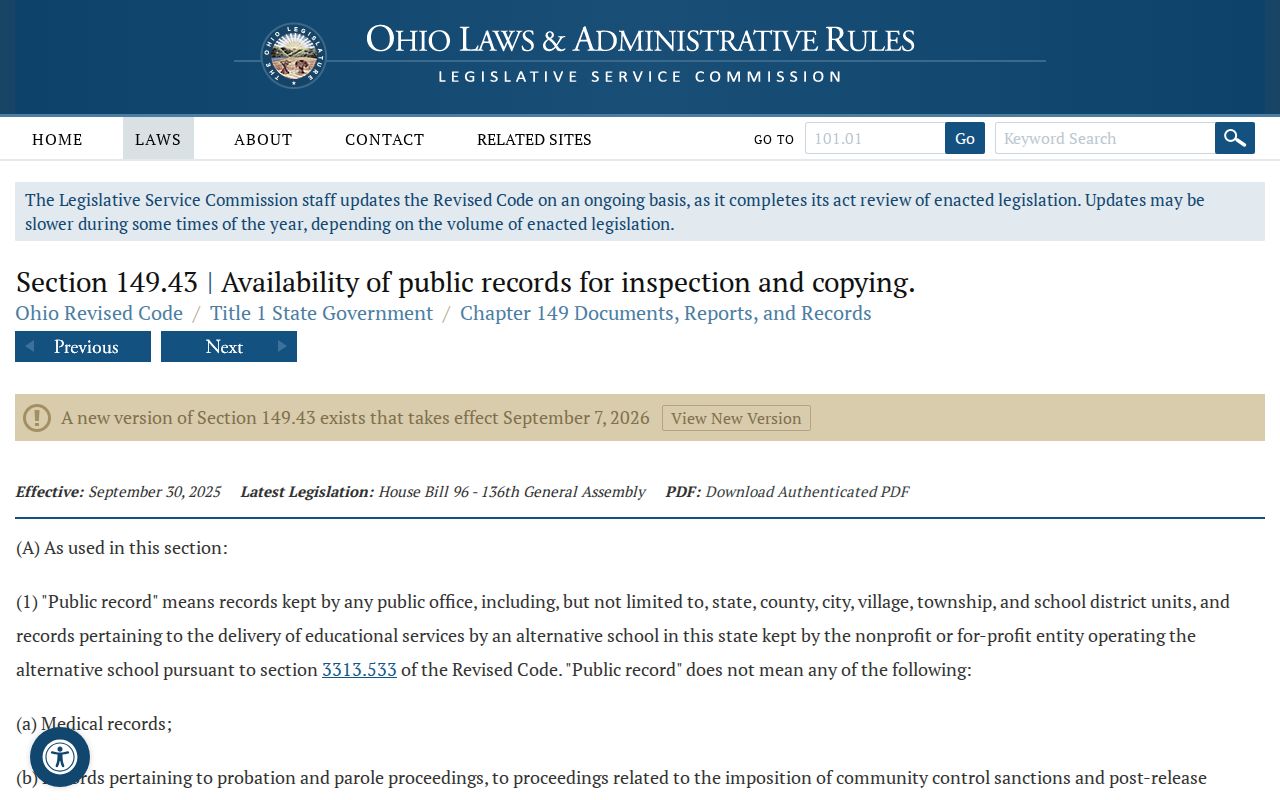
For a judicial case file, go through the clerk that holds it, under the court-record rules.
Lorain County Restricted Court Records
Not everything ends up in a Lorain County court records response. Sealed material, juvenile files, protected domestic-relations information, and personal identifiers can all stay offline or off-limits to copying. Under R.C. 2303.901, filers must leave protected identifiers out of filings. The statute marks out which information is restricted. A public-records request cannot undo a sealing or restriction order from a judge. If a record you expect is not visible, ask the maintaining clerk about the procedure rather than asking the court to change its order. The official statute explains the personal-identifier safeguards. Those safeguards can limit what a Lorain County court records request returns.
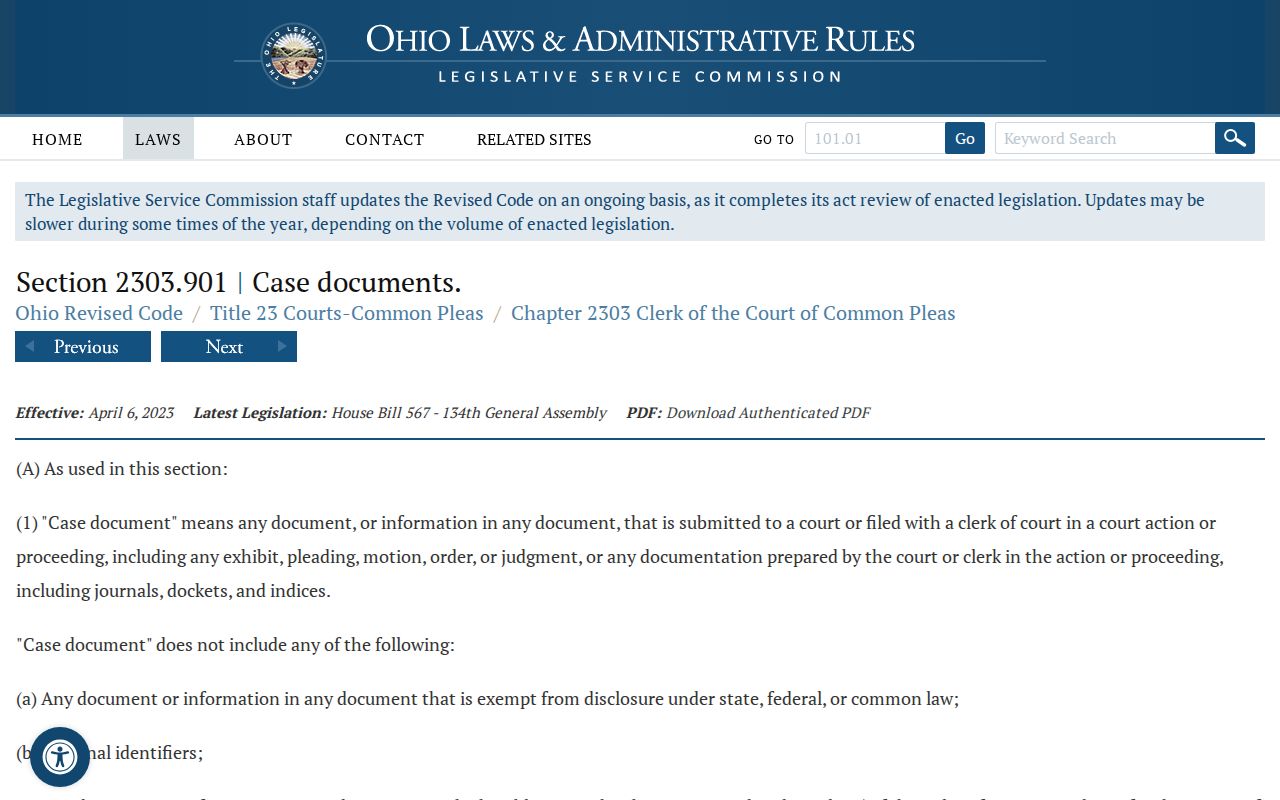
That is why an open docket entry can still hide parts of the file behind it.
Lorain County Federal Court Records
Federal cases do not belong to the Lorain County Clerk. A federal civil or criminal case sits with the U.S. District Court for the Northern District of Ohio. That court points users to CM/ECF and PACER for electronic docket access. Keep the request with whichever court has jurisdiction. A federal case search is no stand-in for a Common Pleas or municipal record request. The Northern District's official court-records instructions make clear how its federal system differs from Lorain County court records.
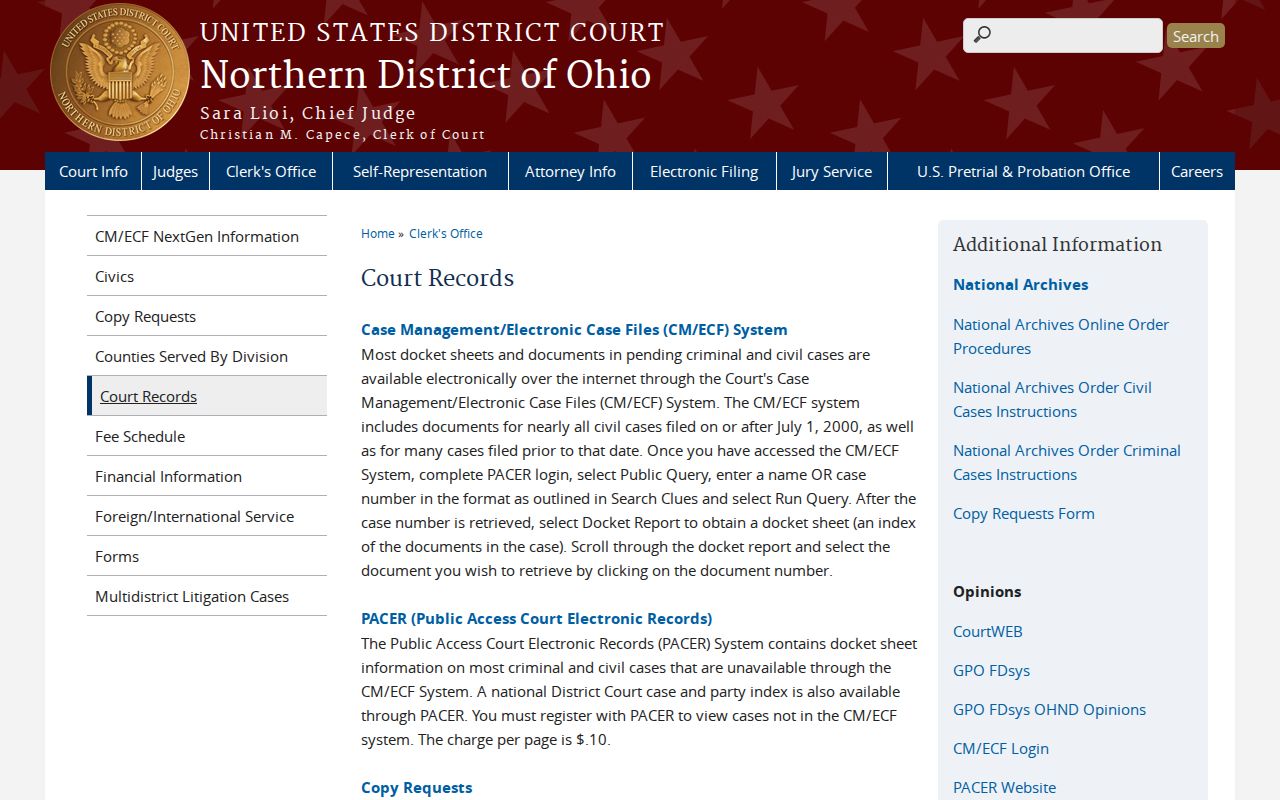
Each clerk can only issue records from the court it serves, so the split matters.
Lorain County Court Record Follow-Up
When an online result comes up short, bring the case number, name the document, and contact the clerk who maintains it. Common Pleas Records answers at 440-329-5511. Probate goes to Probate. Municipal matters go to the court with jurisdiction. The county's case search instructions cover the fuller split between finding a case and getting its official record.