
How to Search Criminal Dockets
Start with the Lorain County Clerk of Courts eServices portal. Use it for any felony indictment or bindover from a municipal court. Computerized criminal records there reach back to 1988. Try the Quick Index or General Index by party name. Once you have a case number, open the Docket Sheets. The Clerk bills those as chronological case summaries of each criminal docket. Misdemeanor, traffic, and ordinance charges stay with the municipal court in whose territory they arose. Ohio offers no statewide trial-court docket search that substitutes for these local systems. Lorain Municipal runs its own Case Search. Oberlin posts a public docket and daily schedule. Avon Lake warns its CaseLook data can lag. Elyria points live lookup questions to its clerk. So begin with the court named on the paperwork.
- Determine whether the charge is a municipal matter or a felony Common Pleas matter.
- Use the official court portal or the clerk’s published access route.
- Search an available party-name index and capture the case number.
- Open the Docket Sheet or local case view and read the newest event.
- Call or visit the maintaining clerk if a result is missing, unclear, or older than online coverage.
Lorain County Felony Dockets
Felony cases in Lorain County land in the Common Pleas Criminal Division. It sits in Justice Center Room 106. That desk covers grand-jury indictments along with bindovers sent up from municipal court. Bring a felony filing or bond question here. For indexes and case files, Records Room 109 is the separate stop. One Lorain County criminal case can mean visiting different clerk contacts. It depends on whether the issue is filing, bond, financial information, or the docket record itself.
Don't treat the Common Pleas General Division as the all-purpose criminal search, though. Municipal courts in Lorain County handle lower-level offenses. They also handle the early stages of felony matters inside their own territories. The usual path runs from a municipal docket or preliminary case to a Common Pleas criminal case. That happens only if a bindover or indictment follows.
Common Pleas Criminal and Records
Justice Center, 225 Court Street, Elyria, OH 44035
Criminal Room 106: 440-329-5538
Records Room 109: 440-329-5511
What a Criminal Docket Shows
Think of a criminal Docket Sheet as a timeline. Every filing and court action appears in the order it happened. The county publishes no complete local docket-code dictionary. Nor is there a public sample felony display. So the safest reading is by plain event type. An entry might point to a complaint or indictment. It could be an arraignment, a plea, bond, a motion, a hearing notice, an order, trial, sentencing, disposition, or an appeal. One caution applies. A docket entry does not prove that every document behind it is on display online.
| Case number | The number used to retrieve a Common Pleas Docket Sheet after an index search. |
|---|---|
| Charging entry | A record of a complaint or indictment entering the court file. |
| Plea or arraignment | A procedural stage where a charge is addressed and a plea is entered. |
| Bond | Release or security terms reflected in the criminal matter. |
| Setting | A scheduled event that must be checked against later entries or court instructions. |
| Disposition | The recorded conclusion, which should not be inferred from an unexplained code. |
A certified copy is still a clerk-held record. That makes it different from an informational docket display.
Lorain County Docket Sheet Order
Start with the case events in order, then hunt for the latest date. A complaint or indictment opens the court path. Arraignment records the formal response. Pretrial events, motions, and hearing notices show the case moving toward trial. Later entries can shift the case status. An order, plea, trial result, sentencing entry, or appeal notice does that. Reading the sequence keeps an old entry from being mistaken for the current procedural event.
Stick to plain language instead of inventing a local abbreviation. A continuation is a court-approved postponement. A reset is just a practical word for a date that moved. A bindover signals a municipal preliminary matter heading into the Common Pleas felony docket.
For an imminent setting, trust the newest docket entry. Also trust any current court instruction over an older notice.
Stages on a Criminal Docket
Criminal cases do not all follow one outcome, but the published court terms support a general process line: Filing → Arraignment → Pretrial → Plea or Trial → Disposition → Sentencing. A municipal felony preliminary proceeding can precede the Common Pleas portion. An appeal notice creates an additional record layer handled through the Clerk’s civil/appellate functions for Ninth District filings.
A setting on a Lorain County criminal docket is not a result. It just marks a planned court event, one that could be continued or moved later. Before you treat any case as finished, read the event label alongside the entries that come after it in the docket.
Lorain County Records Before 1988
Online computerized records for the Common Pleas docket start in 1988. Anything from October 1987 or earlier takes a different route. The Clerk sends those searchers to the Records Division. That way nobody is stuck at a dead-end online docket search. In Room 109 you get terminals with computerized indexes and Docket Sheets. Paper indexes and records there reach back to 1824. That room is the right fallback for a historic Common Pleas criminal docket. It also serves a missing older index result or a request for the underlying case file.
When you contact the Records Division, have the case number ready. Know which record you want. Copy procedures are best confirmed with the staff directly. No universal online copy-request form applies to every Common Pleas criminal record. Nor does a fixed identification rule or set processing time.
Which Court Holds Criminal Dockets
Felony criminal cases in Lorain County sit with the Common Pleas General Division. The municipal courts handle misdemeanors, traffic matters, local ordinance cases, and preliminary felony proceedings. Each does so within its own territory. Lorain Municipal covers Lorain, Sheffield Lake, and Sheffield Township. Elyria Municipal takes Elyria, North Ridgeville, Grafton, LaGrange, and its listed townships. Avon Lake and Oberlin each run their own territorial lower-court systems.
| Criminal matter | Likely docket keeper | First confirmed access channel |
|---|---|---|
| Felony indictment or bindover | Common Pleas Criminal Division | Clerk eServices, Criminal Room 106, or Records Room 109 |
| Lower-level Lorain matter | Lorain Municipal Court | Lorain Municipal Case Search or municipal clerk |
| Lower-level Elyria or North Ridgeville matter | Elyria Municipal Court | Court route or clerk at 440-326-1800 |
| Avon Lake district matter | Avon Lake Municipal Court | CaseLook or the municipal clerk |
Lorain County Municipal Criminal Dockets
Each Lorain County municipal court runs its own docket search, and the gaps between them matter. Lorain Municipal warns that records dated before August 2020 may be inaccurate. For anything older, or anything you need verified, the Clerk is the right stop. Avon Lake posts case information through CaseLook. Postings can lag by at least 24 hours and sometimes longer. When the display looks thin, its published fallback is a request or a visit. Oberlin takes a different approach. It offers individual case dockets plus daily schedules. Elyria confirms on its public site that it handles criminal and traffic matters, though it offers no complete case-search form there.
One more caution: a Common Pleas result never substitutes for a municipal docket search. Even a same-day web result at the municipal level can be incomplete. When a docket display seems off, call the local clerk. Ask about the current setting.
Lorain County Recovery Court Dockets
Treatment dockets exist at both levels of the Lorain County court system. The Elyria Municipal Court local rules set up a Recovery Court. That docket is for alcohol or opiate addiction, serving defendants who deal with either. The rules walk through referral. They also cover clinical and legal eligibility review, a participation agreement or orientation, and the transfer of an accepted case onto the Recovery Court judge’s docket. The case itself stays a court case. Just don’t expect program details to surface in a general public criminal search.
Common Pleas General Division runs its own versions: Recovery Court, Wellness Mental Health Court, and a Veterans Probation Program. Those published descriptions confirm the specialized dockets exist, nothing more. Treatment notes, assessments, and progress reports are sensitive material. The courts do not serve them up remotely. Search the underlying case through the official Common Pleas route. Respect any restriction the court imposes.
Public Access and Sealed Criminal Dockets
Ohio law draws the lines here. Ohio Sup.R. 11.09–11.16 builds the public-access framework for court records, while R.C. 2303.12 and R.C. 2303.901 govern Common Pleas records, remote availability, and personal identifiers. Even so, access has limits. Juvenile records, sealed material, protected information, and anything restricted by court order may stay invisible from afar. And a public-records request for administrative files can never override a sealing or restriction order a court has issued.
Access limit: A missing record can reflect jurisdiction, an online coverage cutoff, a posting delay, or a legal restriction. Ask the clerk holding the case about access procedure, and do not assume a restricted result is available through another public portal.
R.C. 2151.14 is the official juvenile-record confidentiality authority shown below.
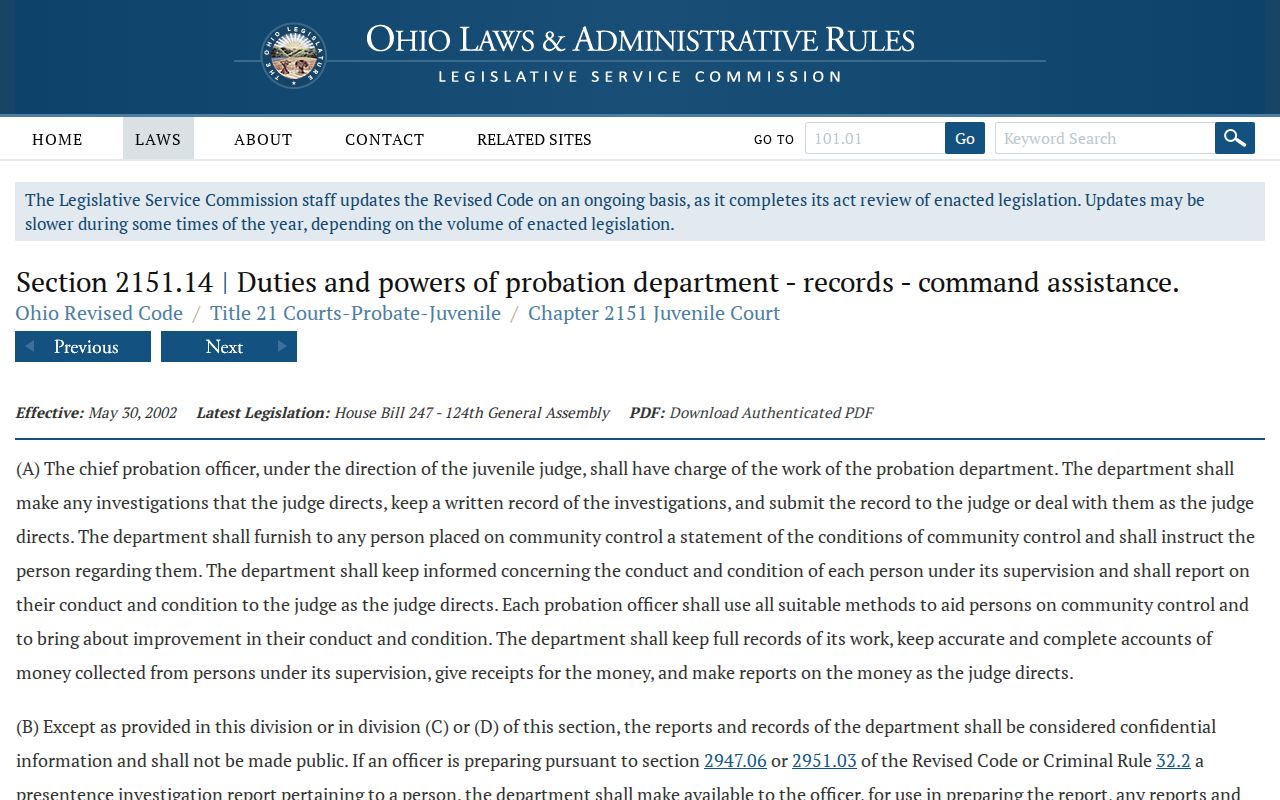
That statute is exactly why a general Lorain County criminal docket search is the wrong tool for juvenile case material. Those records live under their own rules, not under the criminal docket.
Lorain County Sealed Dockets
A sealing order does not slap one uniform label on every result. The wording of the order controls the outcome. An entry may be hidden, restricted, or simply missing. That is what a remote search can show. For convictions and bail forfeitures, R.C. 2953.32 sets out who qualifies, when, how the hearing works, and what the order covers. A different statute governs happier endings. A not-guilty finding, a dismissal, a grand-jury no bill, or a pardon runs through R.C. 2953.33 instead.
The official R.C. 2953.32 source below explains the statutory process. It promises nothing about eligibility. Nor does it say whether any particular record is searchable.
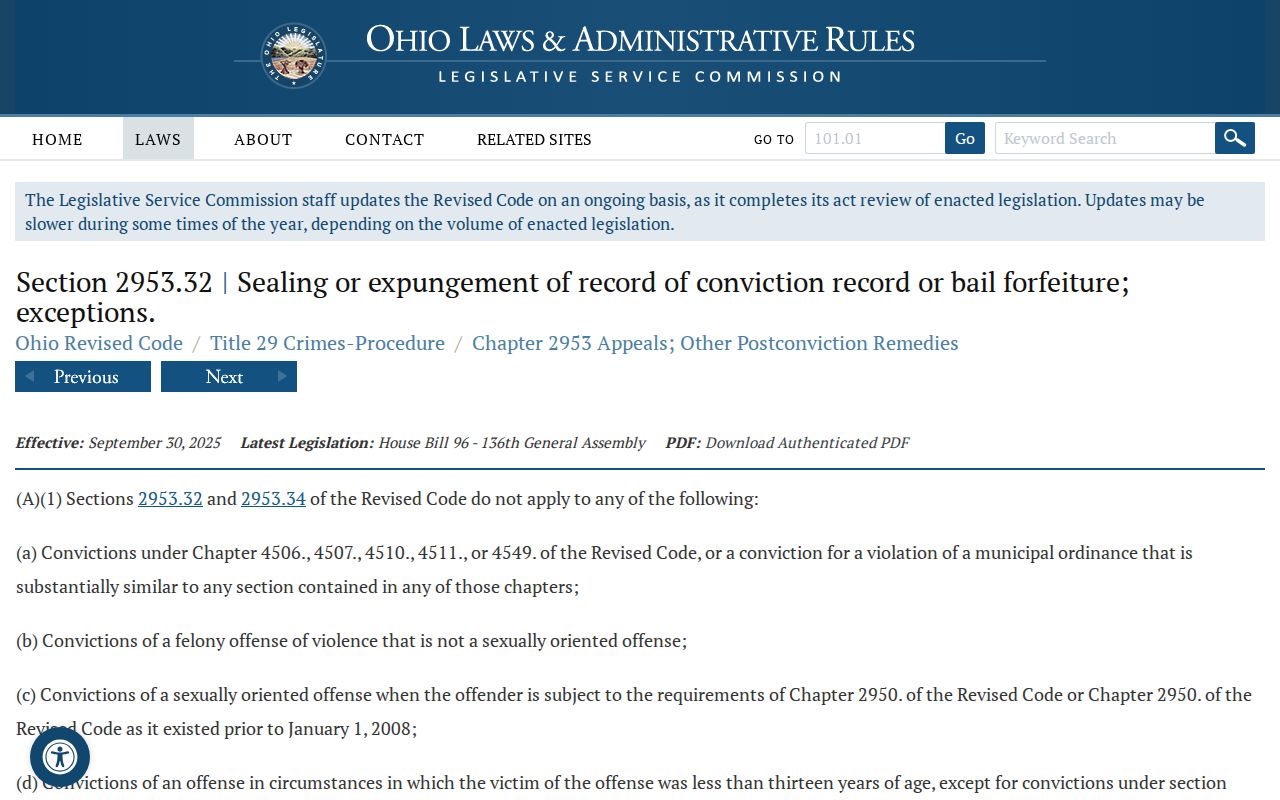
Before filing anything, confirm eligibility and procedure with the sentencing court or whichever court the statute names. The official R.C. 2953.33 source below documents that separate dismissal, no-bill, not-guilty, and pardon route.
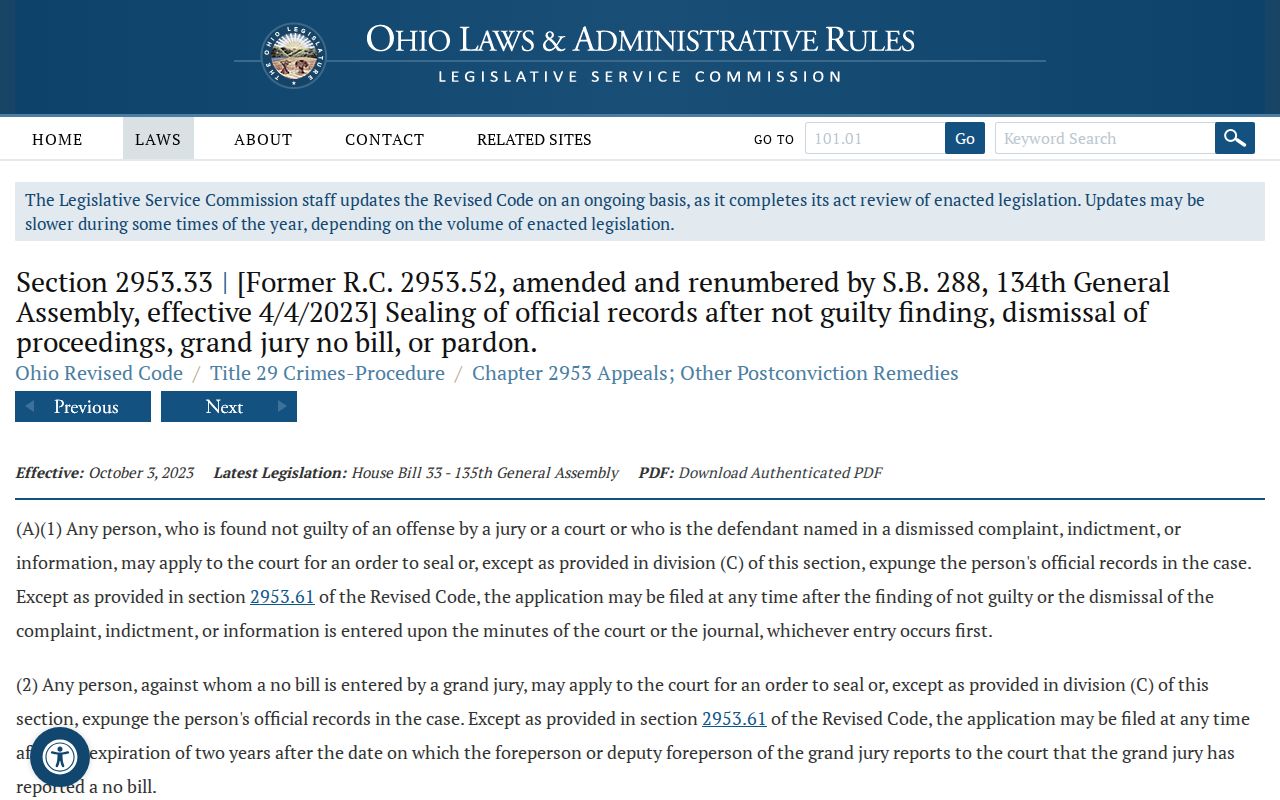
Two statutes, two paths. That split authority is why records with different outcomes never go through one identical sealing process.
Lorain County Criminal Reporting Limits
The Common Pleas Criminal Division reports felony dispositions to Ohio B.C.I.&I. That pipeline is not the court docket. It is not the Clerk’s certified record either. Filings, orders, settings, and the disposition entered in a case still live in the court file. Follow a public matter through the proper court’s own record system and its clerk-held file. Skip the separate reporting database dressed up as case history.
The same distinction helps when a search comes up empty. First figure out what you actually have. Is it a Common Pleas felony, a municipal criminal matter, a protected juvenile case, or an older record outside online coverage? Then go to the matching portal, clerk, counter, or the Records Room 109 terminal.
Lorain County Elyria Sealing Docket
Elyria Municipal Court handles sealing its own way. Its posted instructions point users to R.C. 2953.32, R.C. 2953.33, and related Ohio sealing law. The details differ by outcome. A dismissal or not-guilty packet carries no charge under that court’s instructions. Conviction and bond-forfeiture applications use the local materials and whatever fees are in effect there. Grab the current court form. Don’t carry a municipal process into Common Pleas. Lower-court procedure is court-specific.
For the official local entry point, Elyria Municipal Court’s sealing page lays out what that court requires.
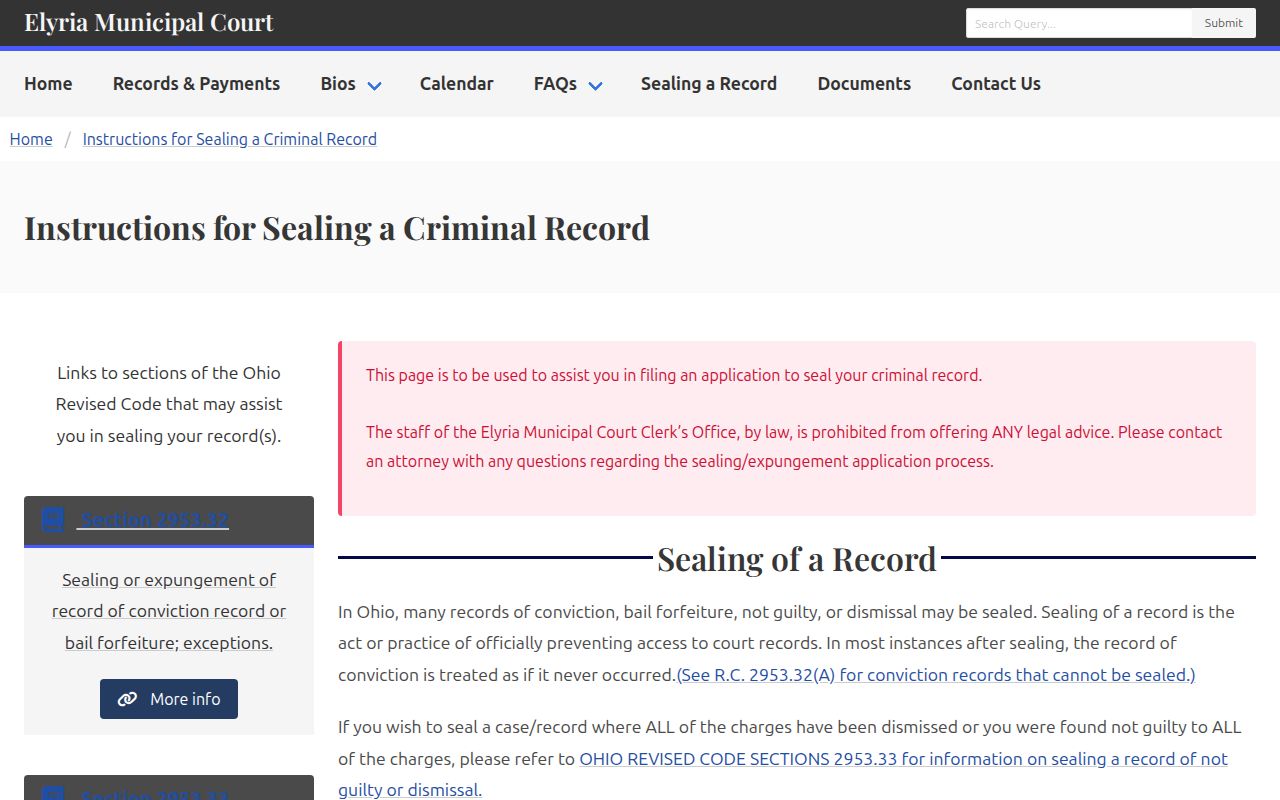
The lesson from the municipal page is simple. Identify the actual court that keeps the criminal docket before you chase any records procedure.